the end of Disability Pride Month
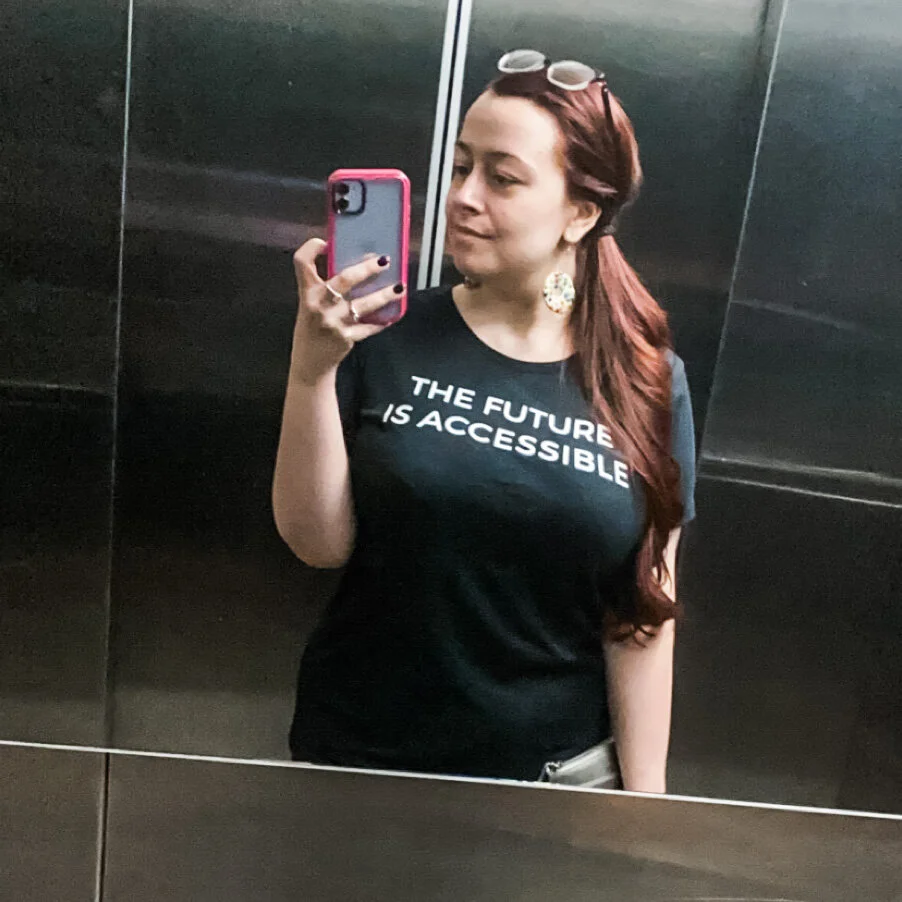
The future is accessible.
Image description: Maddie takes a selfie in an elevator. She has long red hair in a side ponytail, wears doughnut earrings, her glasses are on her head and she snaps the photo with a neutral expression. She wears a black shirt featuring white text that reads “the future is accessible”.
Yesterday - Friday 31st July - marked the end of Disability Pride month.
I had promised myself that I would write a blog post for Disability Pride Month, and started several times. I found that it was tougher than expected to say everything I wanted to without writing an entire book. How do you begin to describe a lifetime’s worth of feelings and experiences that have led to this point?
I guess I’ll start with where I am now.
My name is Madeleine Little. I am a performer, theatre maker, writer, access consultant, researcher, and a proud disabled woman.
Some non-disabled people are confused by the concept of disability pride. I get it. I was once confused, too.
I was confused because, once upon a time, I believed disability was a bad thing. That it was something to be shamed of and something I needed to hide. If kids at school asked ‘what’s wrong with you?’ they wanted to know whether they should avoid me. (I know this because it was explicitly said sometimes, too. ‘I can’t be seen with someone like you.’)
In this post, I could talk all about growing up as a disabled kid and teen. I could tell you all about falling over in the playground, always losing ‘tiggy’ (or ‘tag’), or the shame of having a teacher aide follow me everywhere and some kids not wanting to hang out with me as a result. I could tell you all about high school and how I’d get in trouble for being late to class even though my legs just couldn’t get up and down those stairs any faster, or how the mobility scooter that was meant to help me get from class to class was the beginning of my decreased mobility and increased pain.
I could even tell you all about the number of friends I lost touch with around 18 years old because everyone was going out clubbing all the time and that was never a safe or accessible environment for me. I stopped getting invitations because I could never go. Sometimes, I still feel sad about that.
But it is not my fault that I am disabled.
I am disabled by a society that is yet to recognise I should have equitable access to the same buildings and opportunities as my non-disabled peers.
I am disabled by a society that presents non-disabled perspectives as the most important ones in disability issues.
I am disabled by people who underestimate my capacity and my drive.
I am disabled by people who refuse access.
I am disabled by people who make access my responsibility.
I am disabled by people who grant access, expect applause for it, and who hurt and oppress me in other ways.*
I am disabled because my body is perfectly whole and has worth and value, but society is yet to recognise that.
But you know what? I feel like talking about all the things that make me proud to be disabled.
I am great in a crisis. You would think anxiety would kick in, but when things go horribly wrong, I know I can step up and take charge.
I am an excellent problem solver. I can identify the priorities and work accordingly.
I am a solid advocate for myself and others. I’m still learning everyday, but I know that when something is wrong, it’s my right and responsibility to speak up if I can.
I have really solid values. Transparency, honesty, loyalty and kindness are exceptionally important to me. I try to hold myself to these standards, but as we all do, I falter sometimes. But that’s okay. Because…
I understand that we have to give ourselves the grace to learn and grow at our pace. We don’t know what we don’t know. Sometimes, we have to admit that we didn’t know something and strive to be better in future. The difference between mistakes and failures is growth.
I know that I am the sum of all my parts, not just a single characteristic. But I also know - and am proud - to say that I am disabled.
Truth be told, I could write so much more. Maybe I will, one day. But for now, I’ll just say this.
I wouldn’t know what Disability Pride even was if it weren’t for the incredible disabled activists and elders of the community. Those who have shared encouragement, resources, insights, perspectives. My mentors, my colleagues, my peers, my friends, all of you. Thank you for the wisdom and the comfort… and the peace that comes from finally feeling free to accept myself as I am.
If you are non-disabled and reading this, and still don’t quite understand how ‘Pride’ and ‘Disability’ could go hand in hand, I highly recommend diversifying your social media feed and doing some reading. Your support and allyship can make a difference.
Read:
Social Model of Disability: People With Disability Australia https://pwd.org.au/resources/disability-info/social-model-of-disability/
Language Guide: People with Disability Australia
https://pwd.org.au/wp-content/uploads/2019/08/PWDA_LanguageGuide_A5_WEB.pdf
Follow on Twitter:
@HabenGirma
@autistichoya
@Keah_Maria
@Imani_Barbarin
@WithDownes
@dana_advocacy
@CarlyFindlay
@FPDNAus (First Peoples Disability Network Australia)
@DisabledQBIPOC
@fi_murphy_
@briannasbell
@KaylaCromer17
@HChristinaR
@bluntshovels
@AndiSnelling
@melissablake
@SarahHoubolt
@ferris_knight
@StartingWJulius
@DRNY_org
@RobertHoge
@HelloRachyy
@Erinkyan
@jeshyr
@shaner528
@JessHealyWalton
@VilissaThompson
*I am working on a post about performative accessibility, but am experiencing some writer’s block… If this is something you’d like to read about, please let me know.